Resume Maker vs Resume Builder: Which Should Job Seekers Use?
Pick the right tool in minutes. See when a resume maker wins on speed, when a builder helps more, and how ATS, format, and downloads change it.
 Published by Pika Resume Team|August 3, 2026|12 min read
Resume Maker vs Resume Builder: Which Should Job Seekers Use?
As of August 2026, the short answer is this: use a resume maker when you want speed, a clean layout, and an easy download, and use a resume builder when you need more help writing and tailoring the content. That is the practical split job seekers need when they are deciding how fast they can apply and how much drafting help they want.
Key takeaways
- A resume maker is usually the faster choice for job seekers who already know what they want to say.
- A resume builder is usually better when you need prompts, examples, or AI help to write stronger bullets.
- ATS compatibility depends more on simple formatting and export options than on the tool label.
- If a tool cannot give you a clean PDF or Word file, it is probably not enough for active applications.
- The best choice depends on your timeline, your experience level, and how much editing you want to do yourself.
Resume maker vs. resume builder: the quick answer
A resume maker is the better pick if you want to get a polished resume out quickly, while a resume builder is better if you want more guidance turning rough notes into usable resume content. That is the real split. If you already have your experience in mind and just need a clean format, the maker wins. If you are staring at a blank page, the builder is usually easier to work with, especially if you want a tool that explains what goes where. For a fuller breakdown of what a builder does for job seekers, see this guide to resume builders.
Both can work for ATS, but the safer choice is the one that keeps formatting simple and exports cleanly. If the file comes out as a readable PDF or Word document, you are in better shape than if the tool traps you in a design that looks good on screen and breaks everywhere else.
What job seekers actually need from a resume tool
A good resume tool should help a job seeker finish a resume that is clear, readable, and easy to send. That sounds basic, but it is where many tools fail. People do not need a canvas full of widgets. They need a resume format that gets them through the first screen, keeps section headings obvious, and does not bury the contact details or work history in decorative clutter.
Ease of use matters most for first-time applicants and people who need to create a resume online free and download it right away. If the workflow makes them fight the software before they can write a single bullet, the tool is already too heavy. Download matters too. A tool that only lets users view a draft but not export it in a real file format slows the whole job search down.
ATS compatibility belongs in the same conversation. Recruiters still use applicant tracking systems, and a resume should survive that pass without tables, odd columns, or hard-to-read text blocks. If you want the technical side of that choice, this ATS and format guide shows why simple structure matters more than flashy design.
AI help can be useful, but it has one job: speed up drafting without inventing things. If a tool starts making up qualifications or polishing weak experience into something false, it has crossed the line.
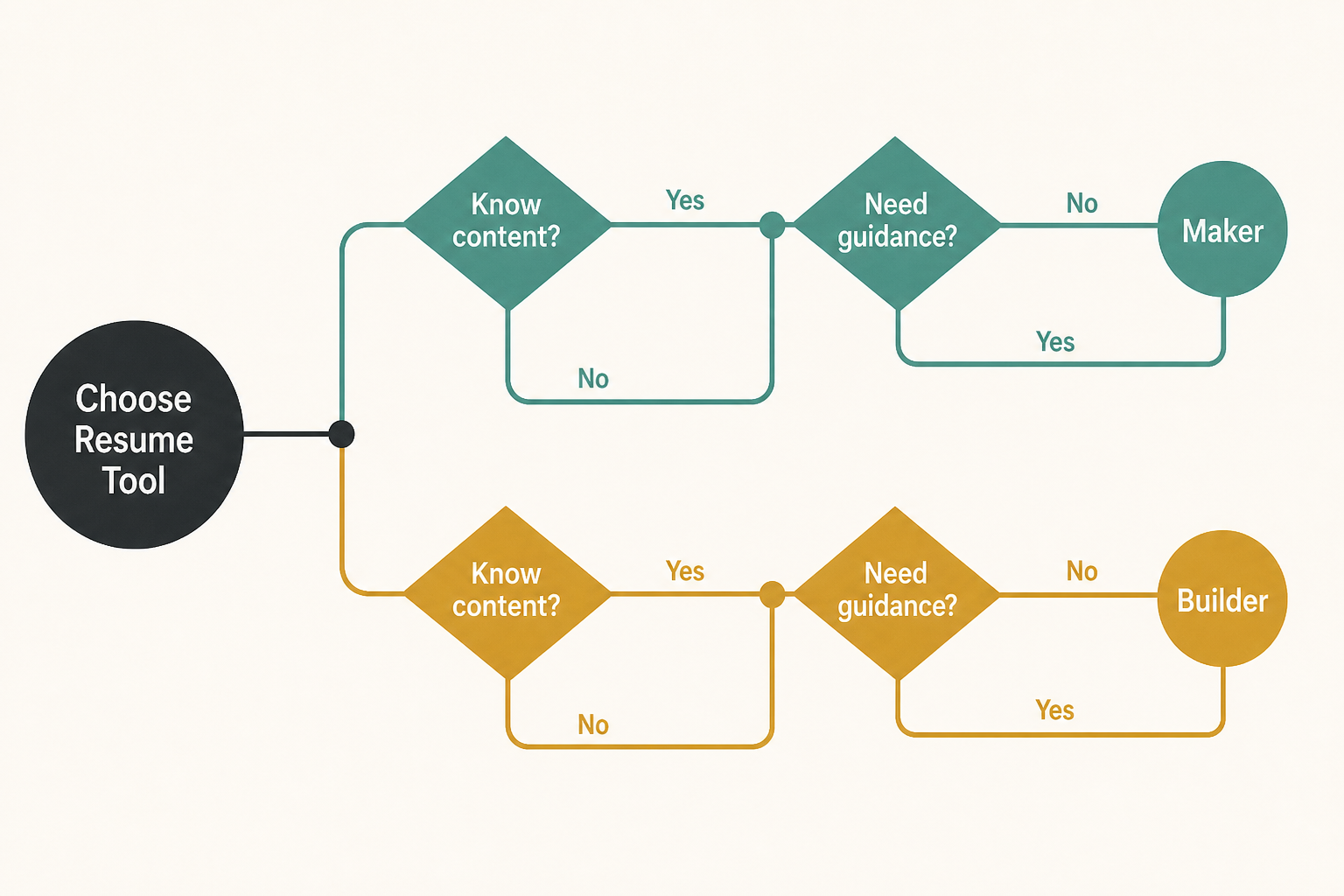
A quick way to match the tool to your workflow.
Resume maker: where it fits best
A resume maker fits best when the job seeker already knows the role they want and just needs a fast, presentable document.
- It is strong for speed. A template-led workflow gets a resume from blank page to finished file without much friction.
- It is useful for simple applications. If the job is straightforward and the resume is short, you do not need heavy writing support.
- It works well when design matters more than drafting help. Visual polish, spacing, and clean export are the main benefits.
- It is often the better choice for quick revisions. Changing a title, moving a section, or switching template styles should not require rebuilding the whole file.
Adobe Express is a clear example of this kind of tool. Adobe says users can create a resume online for free and download the finished resume as a PDF, and it also says its templates are ATS-optimized (Adobe Express resume maker). That combination is exactly why a resume maker appeals to people who want a finished document, not a long writing process. Adobe also says, “After you’ve finished editing, instantly download your finished resume as a PDF to print or share online.”
Resume.com shows a similar free-first pattern. It says its builder is completely free and offers 100% free download in PDF and plain text formats, plus over 100 job-tailored examples to help users start their resume (Resume.com). That is helpful for a job seeker who wants to move quickly but still wants a few examples to reduce blank-page friction.
Canva-style tools often fit this same lane when the main goal is presentation. They are not automatically better for substance. They are better when the user already has the substance and needs a clear visual wrapper around it.
Tip: If you are choosing a resume maker, test the export first. Open the PDF or Word file before you spend time filling in every section. If the spacing, headings, and line breaks survive the export, the tool is probably usable.
Resume builder: where it fits best
A resume builder is the better choice when the job seeker needs help writing, not just formatting.
- It is stronger for guided drafting. Prompts, examples, and structured sections help people who do not know how to phrase experience.
- It helps with tailoring. Good builders make it easier to adjust bullets for a specific role instead of rewriting from scratch.
- It is often better for beginners. Freshers and early-career applicants usually need more support turning skills into resume language.
- It can save time on weak first drafts. Instead of starting with a blank page, the user starts with a draft that can be edited.
That is where resume builder ai features come in. Resume Now says its AI resume builder can generate tailored content for a work experience section from a few words describing the user’s role, and it says users can download resumes in Word and PDF formats (Resume Now). That makes the builder useful for people who know what they did but not how to phrase it cleanly.
Resume Build is another relevant example. It says it offers free resume creation with hundreds of industry-specific templates and pre-written examples, and it invites users to create a professional resume for free by following a few simple steps (Resume Build). That is the core builder promise: reduce friction, give structure, and help the user get to a usable draft faster.
The caution is simple. AI-assisted drafting is only as good as the facts you feed it. A builder should preserve your real background, not quietly upgrade it. Novorésumé puts that plainly: “What you write is what employers read: no fake degrees from an overeager AI, just your real experience presented exactly as you intended.” (Source: Novorésumé, 2026). That is the standard job seekers should apply to any builder that uses AI.
Comparison table: resume maker vs. resume builder
A resume maker is the faster tool for layout and export, while a resume builder is the stronger tool for writing help and guided drafting.
| Criterion | Resume maker | Resume builder |
|---|---|---|
| Main strength | Fast layout and easy export | Guided writing and content help |
| Best for | Job seekers who already know their content | Job seekers who need drafting support |
| Speed | Usually faster | Usually slightly slower, but more helpful |
| Download/export | Often strong, especially PDF | Often strong, sometimes with Word or text export |
| ATS fit | Good if formatting stays simple | Good if templates stay clean and structured |
| Beginner friendliness | Good for confident users | Better for first-timers or freshers |
The practical difference is not cosmetic. It is workflow. A maker helps you assemble a resume. A builder helps you write one.
If you care most about free access and export control, this free resume builder guide breaks down the trade-offs more closely.
Which one should you use for your situation?
Use a resume maker if you already have a solid draft in your head, need to apply quickly, and want the least amount of software friction.
Use a resume builder if you are starting from scratch, have thin experience, or need help turning duties into stronger bullets. That is especially true if you are applying for jobs where your resume needs to be tailored instead of generic.
If you are a fresher or early-career applicant, the builder usually wins because structure matters more than design polish. If you are an experienced applicant who only needs a clean file for tonight’s application, the maker is usually enough.
Cost matters too. Some tools are free at the surface but push exports, templates, or downloads behind a paywall. Before you commit, check the pricing page and compare what you actually get for free versus what requires payment.
How ATS, format, and downloads change the answer
ATS, format, and downloads matter more than the label on the homepage.
A resume can fail for boring reasons: bad spacing, unreadable headings, images in the wrong place, or a format that does not survive export. That is why simple structure wins. Standard section names, consistent dates, and plain text that converts cleanly into PDF or Word are safer than heavily designed layouts. If the resume must pass through software before a human sees it, readability is not optional.
The file format can also decide which tool you use. Adobe Express says it lets users download the finished resume as a PDF. Resume.com says it offers 100% free download in PDF and plain text formats. Resume Now says users can download in Word and PDF. Those details matter because job portals, recruiters, and editing workflows do not all want the same file type.
Some tools also claim ATS support directly. Adobe says its resume maker uses professionally designed and ATS-optimized templates. Resume.com says its builder includes over 100 job-tailored examples to help users start their resume. Those claims do not replace common sense, but they do show how much the market now revolves around parseable formatting rather than just appearance.
Can ChatGPT build a resume?
ChatGPT can help draft resume content, but it should not be the only tool in the workflow.
Used well, it can turn rough notes into bullet ideas, help rewrite a summary, or suggest stronger action verbs. Used badly, it can make the resume sound generic or invent details the candidate never actually had. That is why it works best as a writing assistant, not as the final resume system. Pairing it with a resume maker or resume builder gives the user structure, export options, and a place to verify the final text before sending it.
If you want a deeper look at that workflow, this free AI resume builder guide covers where AI helps and where it fails.
What is the best website to make a resume?
The best website depends on what the job seeker needs most: speed, guidance, or export flexibility.
If the priority is free creation with a quick PDF download, Adobe Express is a strong option. If the priority is free download plus lots of examples, Resume.com is a strong option. If the priority is AI-assisted drafting with popular file formats, Resume Now is a strong option. If the priority is more visual presentation, Canva is often part of the conversation.
There is no universal winner. That is the wrong question. The right question is which site matches the user’s workflow. A job seeker who already has content will value a different tool than one who needs help writing every section.
What is a good free resume builder?
A good free resume builder lets the user create, edit, and download a resume without forcing a paywall too early.
It should also do three other things well. First, it should give enough guidance to help a beginner write actual content. Second, it should keep templates simple enough to stay ATS-friendly. Third, it should offer a real export path, ideally PDF or Word, so the finished file can be used outside the tool.
Resume Build, Resume.com, and Adobe Express each show a different version of that promise. One leans on templates and examples, one leans on free downloads, and one leans on polished presentation with export. That is why the phrase “best free resume builder” usually depends on the reader’s real goal, not on a single universal product ranking.
If you are comparing free options, this guide to free resume builders is the right next read.
Frequently asked questions
What is the best free resume builder?
The best free resume builder is the one that gives you usable export, clean templates, and enough guidance to finish the resume without paying before you are ready. For some people that means a builder with examples. For others it means a simple maker with a free PDF download.
Where can I create a resume for free?
You can create a resume for free on tools that offer no-cost creation and real download options, such as Adobe Express and Resume.com. The important part is not just opening the editor. It is confirming that you can export the finished file in a format you can actually use.
What is a good resume builder?
A good resume builder helps you write, not just format. It should give you prompts, examples, or AI support, keep the structure ATS-friendly, and let you download the finished resume in a standard file type like PDF or Word.


Create your Resume
Your resume is an extension of you. Make it truly yours.
Related Articles
Related guides & tools
Free AI Resume BuilderBuild a tailored, ATS-friendly resume from scratchFree Resume TemplatesChoose a professional layout for your roleATS Resume CheckerCheck your score, parsing and issues before you applyOnline CV MakerCreate a CV with guided sections and templatesOnline Resume EditorEdit an existing PDF without rebuilding its layoutHobbies for ResumeSkills for ResumeLinkedIn to ResumeResume Examples
Continue Reading
Check more recommended readings to get the job of your dreams.
careerBy Pika Resume Team | Aug 3, 2026
Resume Maker vs Resume Builder: Which Should Job Seekers Use?
By Pika Resume Team | Aug 3, 2026
careerBy Pika Resume Team | Aug 2, 2026
Free Resume Builder and Download vs Microsoft Word
By Pika Resume Team | Aug 2, 2026
careerBy Pika Resume Team | Jul 30, 2026
What Is the Best Resume Builder Website for 2026?
By Pika Resume Team | Jul 30, 2026
careerBy Pika Resume Team | Jul 27, 2026
How to Cancel Resume Builder Subscription Without Surprises
By Pika Resume Team | Jul 27, 2026
careerBy Pika Resume Team | Jul 26, 2026
How Much Is Resume Builder? Free vs Paid Explained
By Pika Resume Team | Jul 26, 2026
careerBy Pika Resume Team | Jul 20, 2026
Resume Builder App: What the Best One Lets You Do
By Pika Resume Team | Jul 20, 2026
careerBy Pika Resume Team | Jul 19, 2026
Free Resume Builder and Download: Compare the Best Options
By Pika Resume Team | Jul 19, 2026
careerBy Pika Resume Team | Jul 16, 2026
Free AI Resume Builder: What It Does Well and Fails At
By Pika Resume Team | Jul 16, 2026
careerBy Pika Resume Team | Jul 13, 2026
Resume format for ATS: a simple guide that works
By Pika Resume Team | Jul 13, 2026
careerBy Pika Resume Team | Jul 12, 2026
Canva Resume Builder vs ATS Reality Check
By Pika Resume Team | Jul 12, 2026
careerBy Pika Resume Team | Jul 9, 2026
Free resume builder: what makes one worth using
By Pika Resume Team | Jul 9, 2026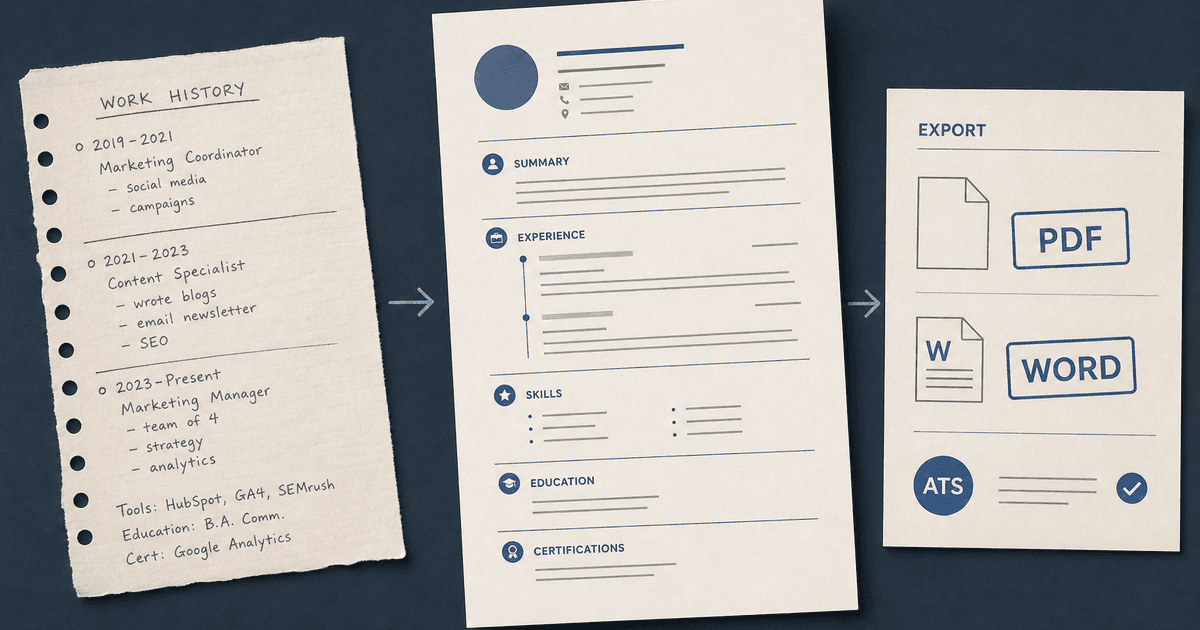
careerBy Pika Resume Team | Jul 6, 2026
Resume Builder: What It Actually Does for Job Seekers
By Pika Resume Team | Jul 6, 2026
resume tipsBy Pika Resume Team | Jun 20, 2026
The Resume Sections Most People Get Wrong (and How to Fix Each One)
By Pika Resume Team | Jun 20, 2026resume tipsBy Pika Resume Team | Jun 18, 2026
How to Edit a PDF Resume Without Wrecking the Formatting
By Pika Resume Team | Jun 18, 2026resume reviewBy Pika Resume Team | Jun 16, 2026
AI Resume Feedback vs a Human Expert Review: When Each Is Worth It
By Pika Resume Team | Jun 16, 2026atsBy Pika Resume Team | Jun 14, 2026
What an ATS Actually Does to Your Resume (and the 8 Things It Scores)
By Pika Resume Team | Jun 14, 2026resume tipsBy Pika Resume Team | Jun 12, 2026
How to Tailor Your Resume to a Job Description in 2026 (the 3-Pass Method)
By Pika Resume Team | Jun 12, 2026resumeBy Gargi Chaudhari | May 30, 2026
Resume vs Biodata vs CV: Which One Do You Actually Need?
By Gargi Chaudhari | May 30, 2026resume By Astha Narang | May 28, 2026
10 Software Engineer Resume Examples That Got Interviews (2026)
By Astha Narang | May 28, 2026resumeBy Gargi Chaudhari | May 26, 2026
How to Convert a LinkedIn Profile to a Resume or CV
By Gargi Chaudhari | May 26, 2026resumeBy Astha Narang | May 23, 2026
Best Resume Format for Indian IT Services Companies (TCS, Infosys, Wipro, Accenture)
By Astha Narang | May 23, 2026resumeBy Gargi Chaudhari | May 21, 2026
The Complete Guide to ATS Resume Screening in India (2026)
By Gargi Chaudhari | May 21, 2026resumeBy Astha Narang | May 19, 2026
Hobbies and Interests for Resume: Should You Include Them?
By Astha Narang | May 19, 2026resumeBy Gargi Chaudhari | May 14, 2026
How to Write a Resume Headline That Gets Recruiter Calls on Naukri
By Gargi Chaudhari | May 14, 2026interviewBy Astha Narang | May 8, 2026
Decoding Interviewer Psychology: What They Don't Tell You for Your Next Job
By Astha Narang | May 8, 2026resumeBy Gargi Chaudhari | May 7, 2026
Career Objective for Resume: 50+ Fresher Examples (2026)
By Gargi Chaudhari | May 7, 2026resumeBy Astha Narang | May 6, 2026
7 Dangerous ATS Myths Debunked: What Actually Gets You Hired in 2026
By Astha Narang | May 6, 2026resumeBy Astha Narang | May 4, 2026
Master Your Resume: The Ultimate Guide to Listing Computer Skills
By Astha Narang | May 4, 2026resumeBy Astha Narang | Apr 29, 2026
4 Sales Resume Examples for SDR, Account Executive & Manager (2026)
By Astha Narang | Apr 29, 2026resumeBy Astha Narang | Apr 29, 2026
4 Data Analyst Resume Examples for 2026 (Entry-Level to Senior)
By Astha Narang | Apr 29, 2026resumeBy Astha Narang | Apr 24, 2026
Resume Tips for 2026: The Ultimate Guide to Landing Interviews
By Astha Narang | Apr 24, 2026resumeBy Astha Narang | Apr 22, 2026
Bad Resume vs. Good Resume: A Side-by-Side Comparison for Job Seekers
By Astha Narang | Apr 22, 2026resumeBy Astha Narang | Apr 20, 2026
How to Add LinkedIn to Your Resume the Right Way in 2026
By Astha Narang | Apr 20, 2026resumeBy Astha Narang | Apr 17, 2026
7 Common Resume Mistakes to Avoid in 2026 (and How to Fix Them)
By Astha Narang | Apr 17, 2026resumeBy Pika Resume Team | Apr 15, 2026
Master Your LinkedIn-to-Resume Link: A 2026 Guide for Top Candidates
By Pika Resume Team | Apr 15, 2026resumeBy Astha Narang | Apr 13, 2026
How to Write a Winning Resume Summary That Grabs Recruiter Attention
By Astha Narang | Apr 13, 2026careerBy Astha Narang | Apr 11, 2026
Owning Your Career Break: How to Frame a Gap Year on Your Resume in 2026
By Astha Narang | Apr 11, 2026resumeBy Astha Narang | Apr 8, 2026
The Complete 2026 Resume Guide: Crafting a Job-Winning Document
By Astha Narang | Apr 8, 2026resumeBy Astha Narang | Apr 4, 2026
Beat the ATS: Optimize Your Resume for Applicant Tracking Systems in 2026
By Astha Narang | Apr 4, 2026resumeBy Astha Narang | Mar 30, 2026
Expert Resume Review: Is It Worth the Investment for Your Career?
By Astha Narang | Mar 30, 2026resumeBy Astha Narang | Mar 27, 2026
How Many References Should You Have on Your Resume?
By Astha Narang | Mar 27, 2026resumeBy Astha Narang | Mar 25, 2026
Master the 30-Second Resume Scan: Expert & Recruiter Insights
By Astha Narang | Mar 25, 2026resumeBy Astha Narang | Mar 24, 2026
How to Explain Employment Gaps on Your Resume & Ace Interviews
By Astha Narang | Mar 24, 2026resumeBy Astha Narang | Mar 20, 2026
Master Resume Keywords: Your Guide to ATS Success
By Astha Narang | Mar 20, 2026careerBy Astha Narang | Mar 18, 2026
How to Stand Out in Interviews While Still Being Authentic
By Astha Narang | Mar 18, 2026careerBy Astha Narang | Mar 14, 2026
Why Sending the Same Resume to Every Job is Costing You Interviews
By Astha Narang | Mar 14, 2026resumeBy Astha Narang | Mar 12, 2026
The Dynamic Duo: Why AI + Human Expertise is the 2026 Career Cheat Code
By Astha Narang | Mar 12, 2026careerBy Astha Narang | Mar 9, 2026
Get Your Resume Roasted Using PIKA AI
By Astha Narang | Mar 9, 2026jobBy Astha Narang | Mar 7, 2026
How to Show a Promotion on Your Resume? (And Why Most People Get It Wrong)
By Astha Narang | Mar 7, 2026careerBy Astha Narang | Mar 6, 2026
Should You Put Your Address on Your Resume in 2026?
By Astha Narang | Mar 6, 2026careerBy Astha Narang | Mar 3, 2026
Is It Illegal to Lie on a Resume? What Actually Happens in 2026
By Astha Narang | Mar 3, 2026jobBy Pika Resume Team | Feb 5, 2026
How to Optimize Your Resume for Remote Job Applications
By Pika Resume Team | Feb 5, 2026interviewBy Pika Resume Team | Feb 1, 2026
How to Write an ATS-Friendly Resume in 2026
By Pika Resume Team | Feb 1, 2026cover-letterBy Pika Resume Team | Jan 25, 2026
Top 7 Cover Letter Mistakes That Cost You the Interview
By Pika Resume Team | Jan 25, 2026resumeBy Pika Resume Team | Jan 18, 2026
AI Resume Builders: A Complete Guide for Job Seekers in 2026
By Pika Resume Team | Jan 18, 2026jobBy Pika Resume Team | Jan 10, 2026
Resume Tips for Career Changers: Making a Smooth Transition
By Pika Resume Team | Jan 10, 2026careerBy Pika Resume Team | Jan 3, 2026
The Power of Keywords in Your Resume: An SEO Approach to Job Applications
By Pika Resume Team | Jan 3, 2026