Free Resume Builder and Download vs Microsoft Word
See which tool gets you a polished resume faster, with cleaner formatting and easier exports. Compare free resume builder and download options now.
 Published by Pika Resume Team|August 2, 2026|12 min read
Free Resume Builder and Download vs Microsoft Word
As of August 2026, a free resume builder and download workflow wins for most job seekers who want a polished file fast. Microsoft Word wins when they want total manual control and do not mind doing the formatting themselves. Pikaresume sits in the middle of that choice: it helps people get from draft to export without turning the resume into a layout project.
Key takeaways
- A free resume builder is the better default for most job seekers because it reduces formatting mistakes and gets a usable file out the door faster.
- Microsoft Word is stronger when the user wants full control over spacing, typography, and section order.
- "Free" does not always mean unlimited. Some tools are free for creation but restrict export formats or premium templates.
- ATS-friendly formatting matters because both recruiters and parsing systems care about clean structure, not just good content.
- The best choice depends on whether the goal is a quick, clean download or a heavily customized master resume.
Which wins for job seekers: free resume builder and download or Microsoft Word?
The free resume builder and download option wins for most job seekers, because it gets them to a finished resume with less friction, fewer formatting errors, and a cleaner export path. Word wins only when the user is willing to spend more time managing layout and wants complete control over every line and margin.
Think in terms of the actual job-search workflow. If someone needs a resume tonight, or wants a version they can apply with before a deadline closes, the builder is usually the faster path. If someone is refining a long-term master resume and already knows how to manage styles, spacing, and PDF export in Word, then Word can be the better tool.
The real decision is not design versus no design. It is how much time the job seeker wants to spend fixing formatting after the content is done.
| Fastest path | Best control |
|---|---|
| Free resume builder and download | Microsoft Word |
| Clean template, simple export, less setup | Precise spacing, section order, custom formatting |
What job seekers actually need from a resume tool
Job seekers usually need four things: fast creation, a solid resume format, ATS-friendly output, and a simple way to download and share the file. That is the whole checklist. Everything else is secondary.
A resume only works if it is readable in two places at once: by a human recruiter and by the software that often screens it first. Clean structure matters because a layout that looks polished on screen can still break when exported, copied, or parsed. That is why resume format is not a cosmetic issue. It affects whether the document survives the application process.
The download path matters just as much. A tool that lets someone build a resume but then buries the export button, limits file types, or pushes a paywall at the end creates extra work right when the reader wants speed. For commercial search intent, that friction is the point. People are not shopping for a writing exercise. They want a finished file they can send.
If you want a broader framework for judging tools, see what makes a free resume builder worth using and the practical formatting notes in this ATS guide.
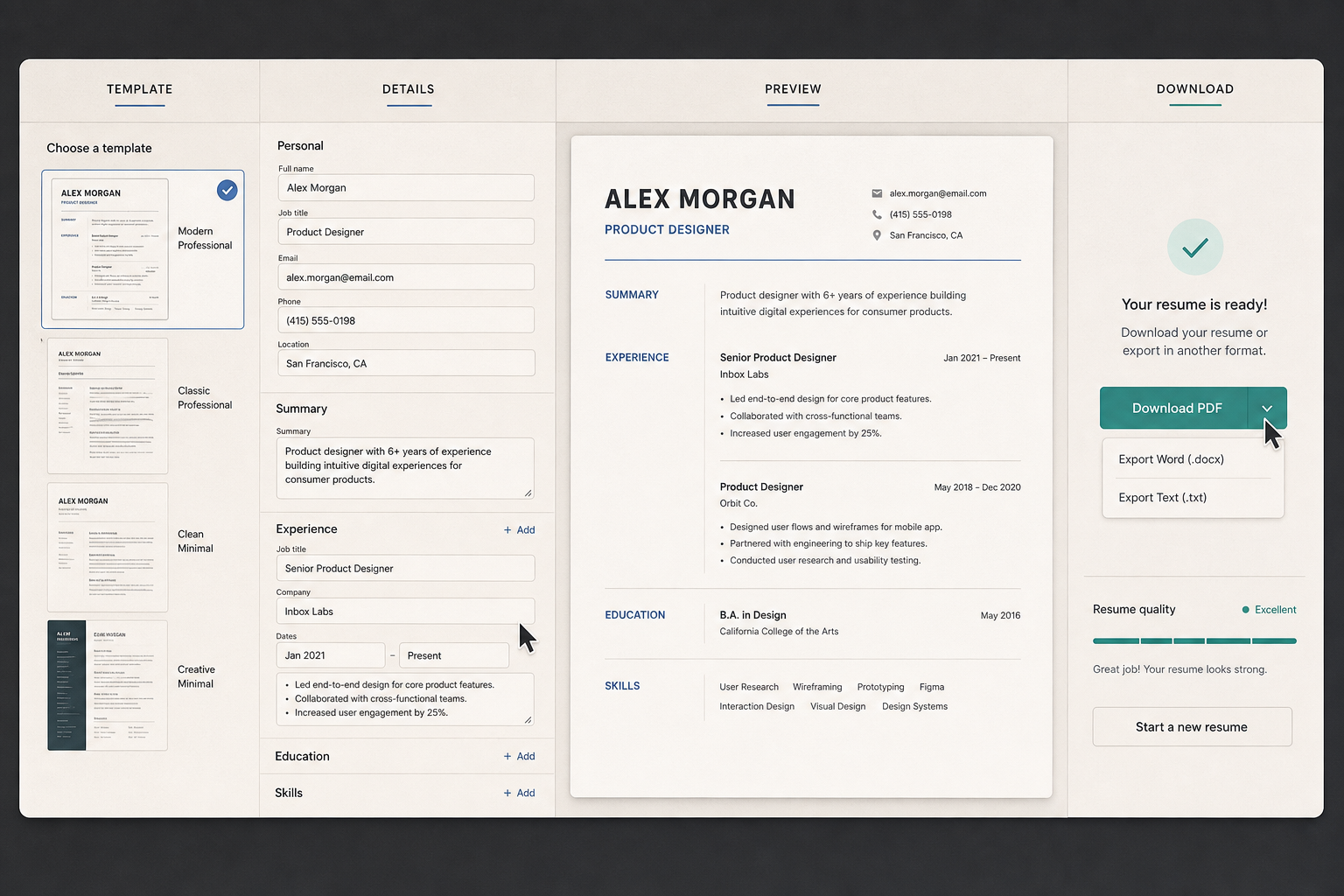
A guided flow cuts down the formatting work before export.
How a free resume builder and download flow works
A free resume builder and download flow usually follows a simple sequence: pick a template, enter your details, preview the layout, and export the finished resume. That is the advantage. The structure is already there, so you are editing content instead of building spacing from scratch.
- Choose a template that fits the role.
- Fill in your contact details, summary, experience, and skills.
- Review the live preview for spacing, section order, and line breaks.
- Download the file in the format you need.
When the workflow is good, the user sees a resume that is already close to final before export. That matters because it removes the most common Word problem: the document looks fine until one edit pushes the whole page out of alignment. Some builders also make it easy to duplicate a version for a different role, which is useful when one job wants a more technical emphasis and another wants a broader summary.
The download step is where the differences show up. Resume.com says its builder is completely free and that users can create, upload, download, and print without paying, including PDF and plain text options; its own wording is blunt: “From creating an account to uploading your resume to downloading and printing, you’ll never pay a dime” (Resume.com). That is the kind of free flow job seekers actually want.
Where Microsoft Word still wins
Microsoft Word wins when the user wants total control over the document and is comfortable managing it manually. That means custom section order, precise spacing, custom typography, and a template-free file that can be adjusted line by line.
Word is also useful for people who treat their resume as a master document. They may keep one core version, then create tailored copies for different roles, changing the emphasis and bullets each time. If they already know how to control styles and export cleanly to PDF, Word can be efficient. If they do not, it becomes a formatting chore.
The trade-off is simple. Word gives more control, but it also makes the user responsible for every layout mistake. That includes inconsistent spacing, awkward page breaks, and formatting drift after edits. A builder takes some of that burden away.
Comparison of cost, export options, and ease of use
The easiest way to compare the two tools is by the work they remove. Free builders remove setup and formatting work. Word removes subscription friction for many users who already have it, but it leaves the layout work in the user's hands.
| Criterion | Free resume builder | Microsoft Word |
|---|---|---|
| Upfront cost | Often free to create and download, but limits vary | Often already installed or included with a subscription |
| Formatting effort | Low, because the template handles structure | High, because the user builds the layout manually |
| Export options | Usually PDF, sometimes DOCX or TXT | PDF and DOCX, depending on the user's workflow |
| Speed to finish | Fast for most users | Slower if the user is formatting from scratch |
| ATS safety | Often better by default when templates are structured | Depends on how carefully the document was built |
Resume-Now shows the split clearly. It says users can try its AI resume builder for free and download a plain-text TXT file before upgrading, while also advertising Word and PDF downloads for popular file formats (Resume-Now). That tells you the real issue is not just whether a tool is free. It is what the free tier actually lets you export.
Adobe Express takes a friendlier position on export, saying users can instantly download a finished resume as a PDF and make and save as many resumes as they like for free (Adobe Express). For a job seeker, that combination is more useful than a feature list. It means they can draft, revise, and export without turning the process into a billing decision.
Is a free resume builder really free?
A free resume builder can be genuinely free, but the word free can cover very different things: free creation, free download, free templates, or free access until the export step.
That is why the fine print matters. Some tools let users build and download a full resume without paying. Others let them start for free, then restrict premium templates, limit formats, or ask for an upgrade right when the resume is ready. The user does the work first and learns the real rules last.
A genuinely free tool should be clear about what it gives up front. Resume.com says its builder is completely free from creation through download and printing. Adobe Express says users can make and save as many resumes as they like for free, then download the finished file as a PDF. Those are strong examples because they separate the free workflow from the upsell.
If you want a direct walkthrough of the free download path, this free builder download guide shows how the flow should work when it is done properly.
“From creating an account to uploading your resume to downloading and printing, you’ll never pay a dime.”Resume.com
Does a free resume builder help with ATS and resume format?
A good free resume builder usually helps with ATS and resume format more than a manual Word build does, especially for job seekers who do not want to fight layout problems.
ATS means Applicant Tracking System, the software many employers use to process resumes. Resume.com says its resumes are ATS-friendly and explains that ATS stands for Applicant Tracking System, which employers use to process resumes. That matters because a structured template reduces the chance that a table, text box, or unusual layout will confuse the parse.
This is where the resume format keyword becomes practical. A neat layout is not just about looking professional. It also helps the file survive upload, conversion, and screening. Word can absolutely produce ATS-safe resumes, but only if the user knows how to keep the structure simple. Builders often make that easier by default.
For readers who want a deeper formatting check, the ATS guide explains the structure decisions that matter most.
Can ChatGPT build a resume, or is a builder better?
ChatGPT can help draft resume content, but a resume builder is better for turning that content into a polished file you can actually download.
That distinction matters. AI can help with bullet wording, summary phrasing, and tailoring a resume to a job description. It cannot reliably replace the layout step unless the user already has a document tool to place the content into. For a job seeker, the useful output is not just better text. It is a resume that exports cleanly.
So the best workflow is usually mixed: use AI to draft or refine, then use a builder to structure and export. If the user wants that split approach, this free AI resume builder guide explains where AI helps and where it stops helping.
When to choose Adobe Acrobat, Canva, or Jobscan instead
Adobe Acrobat, Canva, and Jobscan each solve a narrower problem than a general resume builder, so they make sense only when the user's goal is specific.
Adobe Acrobat is mainly about working with PDFs after the resume already exists. It is useful for final file handling, not for guiding someone from blank page to finished document. Canva is strong for design-heavy layouts, but a design-first resume can create ATS trade-offs if the user prioritizes style over structure. Jobscan is different again: it is useful when the job seeker wants ATS feedback and keyword alignment rather than a full build-and-download workflow.
That is why the comparison should stay practical. If the priority is a fast, clean export, a builder usually wins. If the priority is design, PDF editing, or ATS testing, these tools can fit into the workflow. For a closer look at design-first resumes, this Canva ATS reality check is the right companion piece.
Best free resume builder for different job seeker scenarios
The best free resume builder is the one that matches the user's deadline, comfort level, and export needs.
For a first-time job seeker, the best choice is usually the tool with the clearest template and the simplest download path. For a career changer, the best choice is the one that makes it easy to reorder sections and try different summaries. For someone who just needs a quick PDF for an application portal, the best choice is the one that gets them to export fastest.
Word still makes sense for users who want a master document they can control forever. But for most people, especially anyone who wants a clean file with less setup, a free builder is the better starting point. That is also why the search phrase best free resume builder keeps pulling attention: people are not really asking for a brand name. They are asking which tool will get them a usable resume with the least pain.
If you want a broader selection framework, this best resume builder website guide lays out the criteria that matter.
Frequently asked questions
Is there a 100% free resume builder?
Yes, some resume builders are genuinely 100% free for creation and download, but the user should confirm the export format, template access, and whether any account step is required before starting.
Is there a free resume builder without login and payment?
Some tools offer no-login or no-payment paths, but the user should check whether those paths require an account before export, limit downloads, watermark the file, or restrict templates before investing time in the build.
What is the best free resume builder?
The best free resume builder is the one that gives the user a clean template, a real download option, and ATS-friendly formatting without forcing a paywall at the end.


Create your Resume
Your resume is an extension of you. Make it truly yours.
Related Articles
Related guides & tools
Free AI Resume BuilderBuild a tailored, ATS-friendly resume from scratchFree Resume TemplatesChoose a professional layout for your roleATS Resume CheckerCheck your score, parsing and issues before you applyOnline CV MakerCreate a CV with guided sections and templatesOnline Resume EditorEdit an existing PDF without rebuilding its layoutHobbies for ResumeSkills for ResumeLinkedIn to ResumeResume Examples
Continue Reading
Check more recommended readings to get the job of your dreams.
careerBy Pika Resume Team | Aug 3, 2026
Resume Maker vs Resume Builder: Which Should Job Seekers Use?
By Pika Resume Team | Aug 3, 2026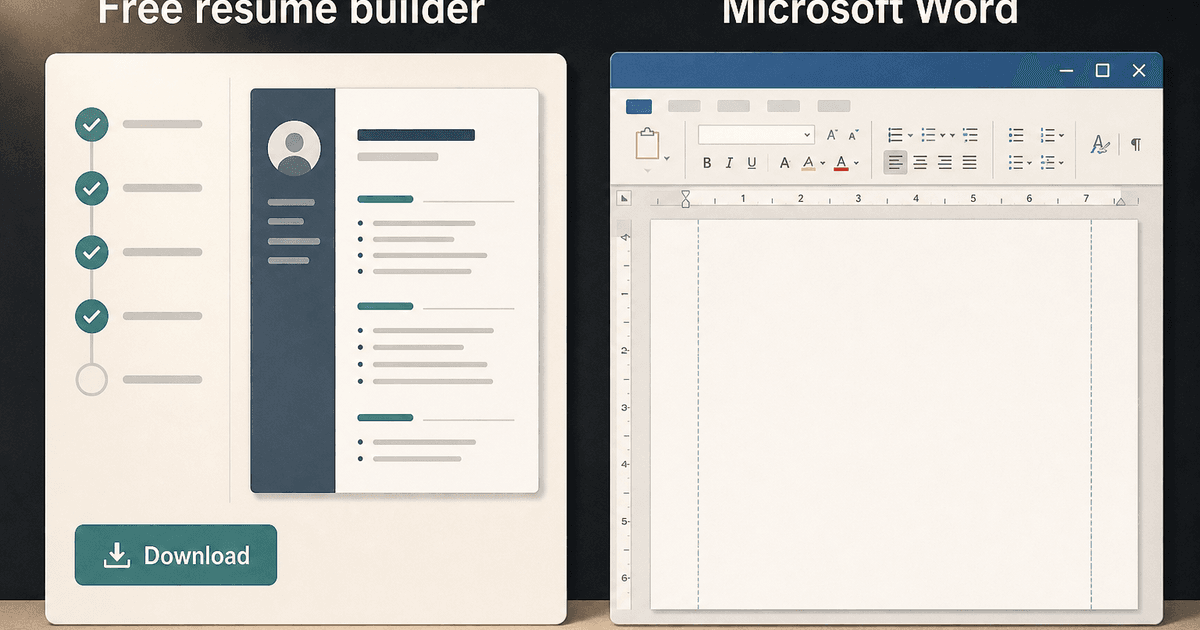
careerBy Pika Resume Team | Aug 2, 2026
Free Resume Builder and Download vs Microsoft Word
By Pika Resume Team | Aug 2, 2026
careerBy Pika Resume Team | Jul 30, 2026
What Is the Best Resume Builder Website for 2026?
By Pika Resume Team | Jul 30, 2026
careerBy Pika Resume Team | Jul 27, 2026
How to Cancel Resume Builder Subscription Without Surprises
By Pika Resume Team | Jul 27, 2026
careerBy Pika Resume Team | Jul 26, 2026
How Much Is Resume Builder? Free vs Paid Explained
By Pika Resume Team | Jul 26, 2026
careerBy Pika Resume Team | Jul 20, 2026
Resume Builder App: What the Best One Lets You Do
By Pika Resume Team | Jul 20, 2026
careerBy Pika Resume Team | Jul 19, 2026
Free Resume Builder and Download: Compare the Best Options
By Pika Resume Team | Jul 19, 2026
careerBy Pika Resume Team | Jul 16, 2026
Free AI Resume Builder: What It Does Well and Fails At
By Pika Resume Team | Jul 16, 2026
careerBy Pika Resume Team | Jul 13, 2026
Resume format for ATS: a simple guide that works
By Pika Resume Team | Jul 13, 2026
careerBy Pika Resume Team | Jul 12, 2026
Canva Resume Builder vs ATS Reality Check
By Pika Resume Team | Jul 12, 2026
careerBy Pika Resume Team | Jul 9, 2026
Free resume builder: what makes one worth using
By Pika Resume Team | Jul 9, 2026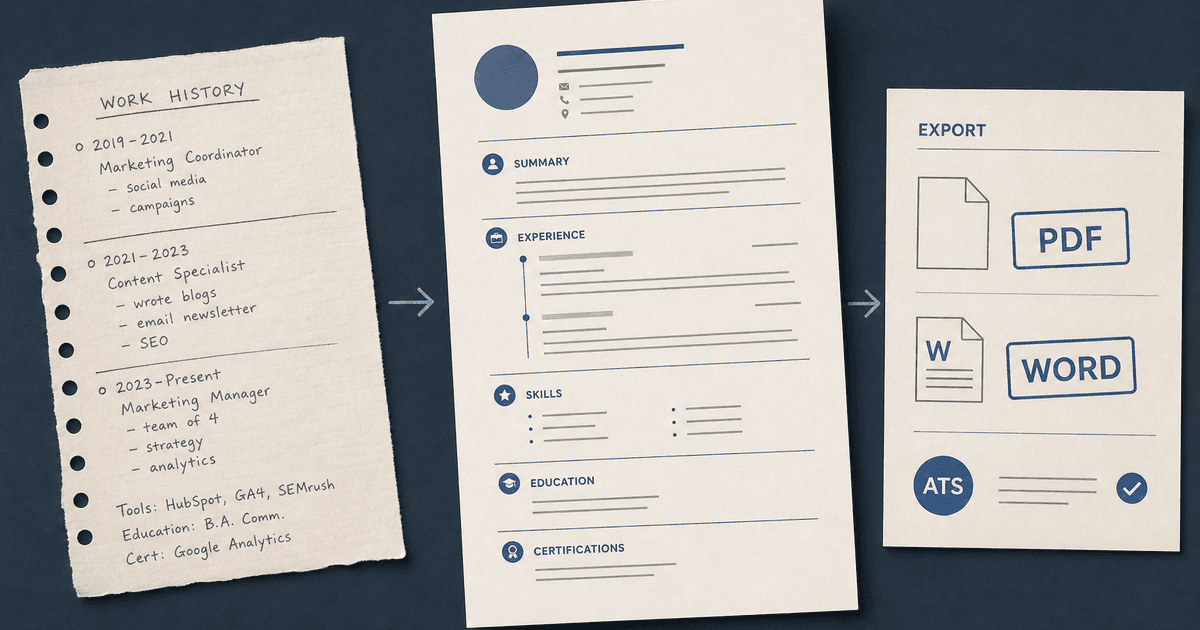
careerBy Pika Resume Team | Jul 6, 2026
Resume Builder: What It Actually Does for Job Seekers
By Pika Resume Team | Jul 6, 2026
resume tipsBy Pika Resume Team | Jun 20, 2026
The Resume Sections Most People Get Wrong (and How to Fix Each One)
By Pika Resume Team | Jun 20, 2026resume tipsBy Pika Resume Team | Jun 18, 2026
How to Edit a PDF Resume Without Wrecking the Formatting
By Pika Resume Team | Jun 18, 2026resume reviewBy Pika Resume Team | Jun 16, 2026
AI Resume Feedback vs a Human Expert Review: When Each Is Worth It
By Pika Resume Team | Jun 16, 2026atsBy Pika Resume Team | Jun 14, 2026
What an ATS Actually Does to Your Resume (and the 8 Things It Scores)
By Pika Resume Team | Jun 14, 2026resume tipsBy Pika Resume Team | Jun 12, 2026
How to Tailor Your Resume to a Job Description in 2026 (the 3-Pass Method)
By Pika Resume Team | Jun 12, 2026resumeBy Gargi Chaudhari | May 30, 2026
Resume vs Biodata vs CV: Which One Do You Actually Need?
By Gargi Chaudhari | May 30, 2026resume By Astha Narang | May 28, 2026
10 Software Engineer Resume Examples That Got Interviews (2026)
By Astha Narang | May 28, 2026resumeBy Gargi Chaudhari | May 26, 2026
How to Convert a LinkedIn Profile to a Resume or CV
By Gargi Chaudhari | May 26, 2026resumeBy Astha Narang | May 23, 2026
Best Resume Format for Indian IT Services Companies (TCS, Infosys, Wipro, Accenture)
By Astha Narang | May 23, 2026resumeBy Gargi Chaudhari | May 21, 2026
The Complete Guide to ATS Resume Screening in India (2026)
By Gargi Chaudhari | May 21, 2026resumeBy Astha Narang | May 19, 2026
Hobbies and Interests for Resume: Should You Include Them?
By Astha Narang | May 19, 2026resumeBy Gargi Chaudhari | May 14, 2026
How to Write a Resume Headline That Gets Recruiter Calls on Naukri
By Gargi Chaudhari | May 14, 2026interviewBy Astha Narang | May 8, 2026
Decoding Interviewer Psychology: What They Don't Tell You for Your Next Job
By Astha Narang | May 8, 2026resumeBy Gargi Chaudhari | May 7, 2026
Career Objective for Resume: 50+ Fresher Examples (2026)
By Gargi Chaudhari | May 7, 2026resumeBy Astha Narang | May 6, 2026
7 Dangerous ATS Myths Debunked: What Actually Gets You Hired in 2026
By Astha Narang | May 6, 2026resumeBy Astha Narang | May 4, 2026
Master Your Resume: The Ultimate Guide to Listing Computer Skills
By Astha Narang | May 4, 2026resumeBy Astha Narang | Apr 29, 2026
4 Sales Resume Examples for SDR, Account Executive & Manager (2026)
By Astha Narang | Apr 29, 2026resumeBy Astha Narang | Apr 29, 2026
4 Data Analyst Resume Examples for 2026 (Entry-Level to Senior)
By Astha Narang | Apr 29, 2026resumeBy Astha Narang | Apr 24, 2026
Resume Tips for 2026: The Ultimate Guide to Landing Interviews
By Astha Narang | Apr 24, 2026resumeBy Astha Narang | Apr 22, 2026
Bad Resume vs. Good Resume: A Side-by-Side Comparison for Job Seekers
By Astha Narang | Apr 22, 2026resumeBy Astha Narang | Apr 20, 2026
How to Add LinkedIn to Your Resume the Right Way in 2026
By Astha Narang | Apr 20, 2026resumeBy Astha Narang | Apr 17, 2026
7 Common Resume Mistakes to Avoid in 2026 (and How to Fix Them)
By Astha Narang | Apr 17, 2026resumeBy Pika Resume Team | Apr 15, 2026
Master Your LinkedIn-to-Resume Link: A 2026 Guide for Top Candidates
By Pika Resume Team | Apr 15, 2026resumeBy Astha Narang | Apr 13, 2026
How to Write a Winning Resume Summary That Grabs Recruiter Attention
By Astha Narang | Apr 13, 2026careerBy Astha Narang | Apr 11, 2026
Owning Your Career Break: How to Frame a Gap Year on Your Resume in 2026
By Astha Narang | Apr 11, 2026resumeBy Astha Narang | Apr 8, 2026
The Complete 2026 Resume Guide: Crafting a Job-Winning Document
By Astha Narang | Apr 8, 2026resumeBy Astha Narang | Apr 4, 2026
Beat the ATS: Optimize Your Resume for Applicant Tracking Systems in 2026
By Astha Narang | Apr 4, 2026resumeBy Astha Narang | Mar 30, 2026
Expert Resume Review: Is It Worth the Investment for Your Career?
By Astha Narang | Mar 30, 2026resumeBy Astha Narang | Mar 27, 2026
How Many References Should You Have on Your Resume?
By Astha Narang | Mar 27, 2026resumeBy Astha Narang | Mar 25, 2026
Master the 30-Second Resume Scan: Expert & Recruiter Insights
By Astha Narang | Mar 25, 2026resumeBy Astha Narang | Mar 24, 2026
How to Explain Employment Gaps on Your Resume & Ace Interviews
By Astha Narang | Mar 24, 2026resumeBy Astha Narang | Mar 20, 2026
Master Resume Keywords: Your Guide to ATS Success
By Astha Narang | Mar 20, 2026careerBy Astha Narang | Mar 18, 2026
How to Stand Out in Interviews While Still Being Authentic
By Astha Narang | Mar 18, 2026careerBy Astha Narang | Mar 14, 2026
Why Sending the Same Resume to Every Job is Costing You Interviews
By Astha Narang | Mar 14, 2026resumeBy Astha Narang | Mar 12, 2026
The Dynamic Duo: Why AI + Human Expertise is the 2026 Career Cheat Code
By Astha Narang | Mar 12, 2026careerBy Astha Narang | Mar 9, 2026
Get Your Resume Roasted Using PIKA AI
By Astha Narang | Mar 9, 2026jobBy Astha Narang | Mar 7, 2026
How to Show a Promotion on Your Resume? (And Why Most People Get It Wrong)
By Astha Narang | Mar 7, 2026careerBy Astha Narang | Mar 6, 2026
Should You Put Your Address on Your Resume in 2026?
By Astha Narang | Mar 6, 2026careerBy Astha Narang | Mar 3, 2026
Is It Illegal to Lie on a Resume? What Actually Happens in 2026
By Astha Narang | Mar 3, 2026jobBy Pika Resume Team | Feb 5, 2026
How to Optimize Your Resume for Remote Job Applications
By Pika Resume Team | Feb 5, 2026interviewBy Pika Resume Team | Feb 1, 2026
How to Write an ATS-Friendly Resume in 2026
By Pika Resume Team | Feb 1, 2026cover-letterBy Pika Resume Team | Jan 25, 2026
Top 7 Cover Letter Mistakes That Cost You the Interview
By Pika Resume Team | Jan 25, 2026resumeBy Pika Resume Team | Jan 18, 2026
AI Resume Builders: A Complete Guide for Job Seekers in 2026
By Pika Resume Team | Jan 18, 2026jobBy Pika Resume Team | Jan 10, 2026
Resume Tips for Career Changers: Making a Smooth Transition
By Pika Resume Team | Jan 10, 2026careerBy Pika Resume Team | Jan 3, 2026
The Power of Keywords in Your Resume: An SEO Approach to Job Applications
By Pika Resume Team | Jan 3, 2026